How to choose a web designer: six checks before you sign
What to ask for and what proof to look at when choosing a web designer or agency, including the technical questions that separate pretty from working.
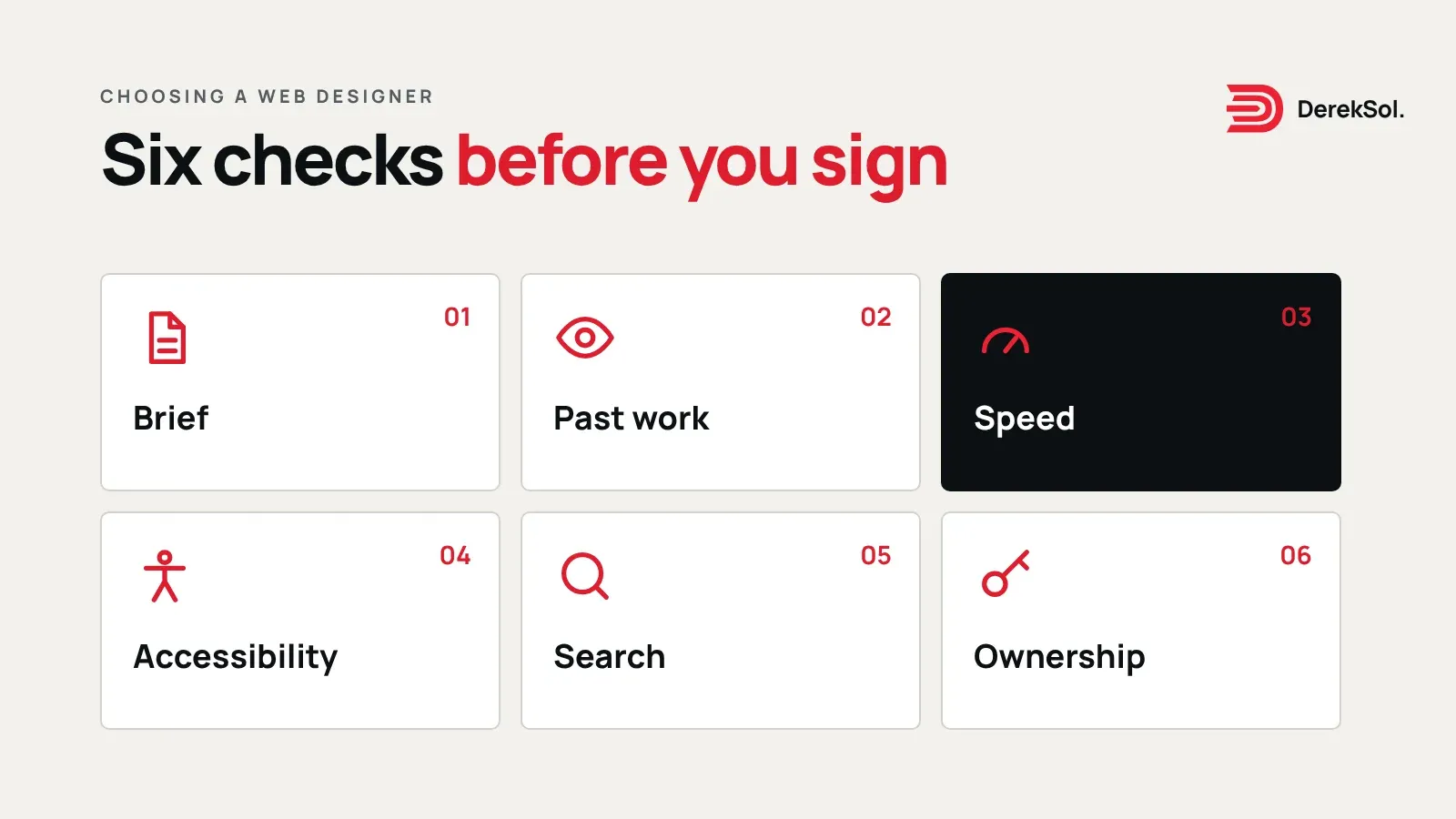
Choosing a web designer is mostly a question of evidence. Anyone can show a polished portfolio. What helps you decide is what they can show about the parts you cannot see: speed, accessibility, how the site is found, and what happens after launch.
The mathematician and physicist Ibn al-Haytham (d. c. 430 AH / c. 1040 CE) described this attitude nearly a thousand years ago, writing about how to read the works of earlier scholars:1
«… بَلْ طَالِبُ الْحَقِّ هُوَ الْمُتَّهِمُ لِظَنِّهِ فِيهِمْ، الْمُتَوَقِّفُ فِيمَا يَفْهَمُهُ عَنْهُمْ، الْمُتَّبِعُ الْحُجَّةَ وَالْبُرْهَانَ، لَا قَوْلَ الْقَائِلِ الَّذِي هُوَ إِنْسَانٌ»
“… Rather, the seeker of truth is the one who suspects his good opinion of them, who pauses over what he understands from them, and who follows argument and proof, not the word of a speaker who is human.”
الحسن بن الهيثم، «الشكوك على بطليموس»، ص ٣–٤
The same applies to a portfolio: follow the proof, not the claim. Here are six checks, in the order we would run them. We are a web agency, so you should apply the same checks to us.
1. Know what you are asking for
Designers can only quote accurately for a clear request. Before you contact anyone, write down your goal, your audience, the pages you need, your deadline and your budget range. We cover this in How to brief a website project on one page.
A good designer will ask questions about this brief. If a quote arrives without any, treat the number with caution: it is a guess.
2. Look at the work, then ask what the project was
A portfolio shows taste. It does not show your designer’s part in the result. Ask for each project:
- What was the problem, and what did you change?
- What was your role, and who else worked on it?
- Is the site live, and may I open it on my phone?
Open the live sites yourself. Check how they load on a mobile connection, whether text is readable, and whether the pages still work when you resize the window. Be wary of a portfolio that contains only images and no links.
The philosopher Immanuel Kant gave the Enlightenment a motto in 1784 that suits this step:2
„Sapere aude! Habe Muth dich deines eigenen Verstandes zu bedienen!“
“Dare to know! Have the courage to use your own understanding!”
A designer’s own description of a project is a claim. The live site is the evidence.
3. Ask how they measure speed
Page speed is a technical result, and it can be measured. Google’s guidance defines three Core Web Vitals: Largest Contentful Paint should occur within 2.5 seconds, Interaction to Next Paint should be 200 milliseconds or less, and Cumulative Layout Shift should be 0.1 or less, measured at the 75th percentile of page loads.3
Ask the designer which of these they check, with which tool, and what they do when a page fails. A confident answer names specific measures. Be cautious of a promise like “your site will be fast” with no way to test it. Our explainer on Core Web Vitals covers each measure.
4. Ask about accessibility, and put it in writing
Accessibility is both a quality issue and, in many places, a legal one. The Web Content Accessibility Guidelines (WCAG) 2.2 are published by the W3C and are also available as the international standard ISO/IEC 40500:2025.4 Their testable criteria are set at three levels: A, AA and AAA.4
Ask which level the designer builds to and how they test it. Then write the level into the contract. We are not lawyers, and the legal requirement depends on where you operate, so ask a professional if that matters for your business.
5. Ask what happens to your search visibility
If you are replacing an existing site, changed addresses can cost you the visitors you already have. Google’s documentation on moving a site advises mapping every old URL to its new equivalent, using permanent server-side redirects, avoiding redirect chains, and keeping redirects in place for at least a year.5
Ask your designer whether the plan includes this. If your site is new, ask how they handle page titles, descriptions and headings. Do not accept promises about rankings: no designer controls how search engines rank a site.
6. Agree who owns what, and what happens after launch
Before you sign, get these answers in writing:
- Ownership. Who owns the design files, the code and the domain name? Your domain should be registered in your name.
- Access. Will you receive the logins for hosting and any tools the site depends on?
- Changes. How many rounds of revision are included, and how are extra changes priced?
- Support. Who fixes problems after launch, how fast, and at what cost?
- Exit. Can another designer take over the site if you part ways?
Warning signs
- A fixed price quoted before anyone has asked you a question.
- Guaranteed search rankings or guaranteed traffic.
- No live examples, or examples they cannot explain.
- Reluctance to put accessibility, ownership or support in the contract.
A simple way to compare proposals
When you have two or three proposals, put them in one table with the same rows: scope, timeline, price, what is excluded, speed and accessibility targets, ownership, and support. Differences in what is excluded often explain differences in price.
What this guide does not cover
This guide is about the evidence you can ask for. It does not compare specific agencies, and it does not replace legal advice on contracts or accessibility law.
References
Footnotes
-
Ibn al-Haytham (d. c. 430 AH). al-Shukūk ʿalā Baṭlamyūs, ed. ʿAbd al-Ḥamīd Ṣabra and Nabīl al-Shihābī (Maṭbaʿat Dār al-Kutub, Egypt, 1971), pp. 3–4. Quoted as given by Nāṣir al-Dīn al-Asad, “al-Islām fī muwājahat al-ḥadātha al-shāmila”, Majallat Majmaʿ al-Fiqh al-Islāmī, issue 11, p. 679 in Shamela’s automatic page numbering. The same wording appears in Haytham ibn Fahd al-Rūmī, al-Majālis al-fiqhiyya, p. 178 (printed page number). We have compared these two transmissions with each other; we have not seen the 1971 printed edition. ↩
-
Immanuel Kant. “Beantwortung der Frage: Was ist Aufklärung?”, Berlinische Monatsschrift, vol. 4, no. 12 (December 1784), pp. 481–494; the passage is on p. 481. Read in the Deutsches Textarchiv transcription of the volume, with the long s (ſ) printed as s. ↩
-
web.dev. Web Vitals. Last updated 31 October 2024; read 25 October 2026. ↩
-
W3C Web Accessibility Initiative. WCAG 2 Overview. Read 25 October 2026. ↩ ↩2
-
Google Search Central. Site moves with URL changes. Last updated 20 August 2026; read 25 October 2026. ↩